
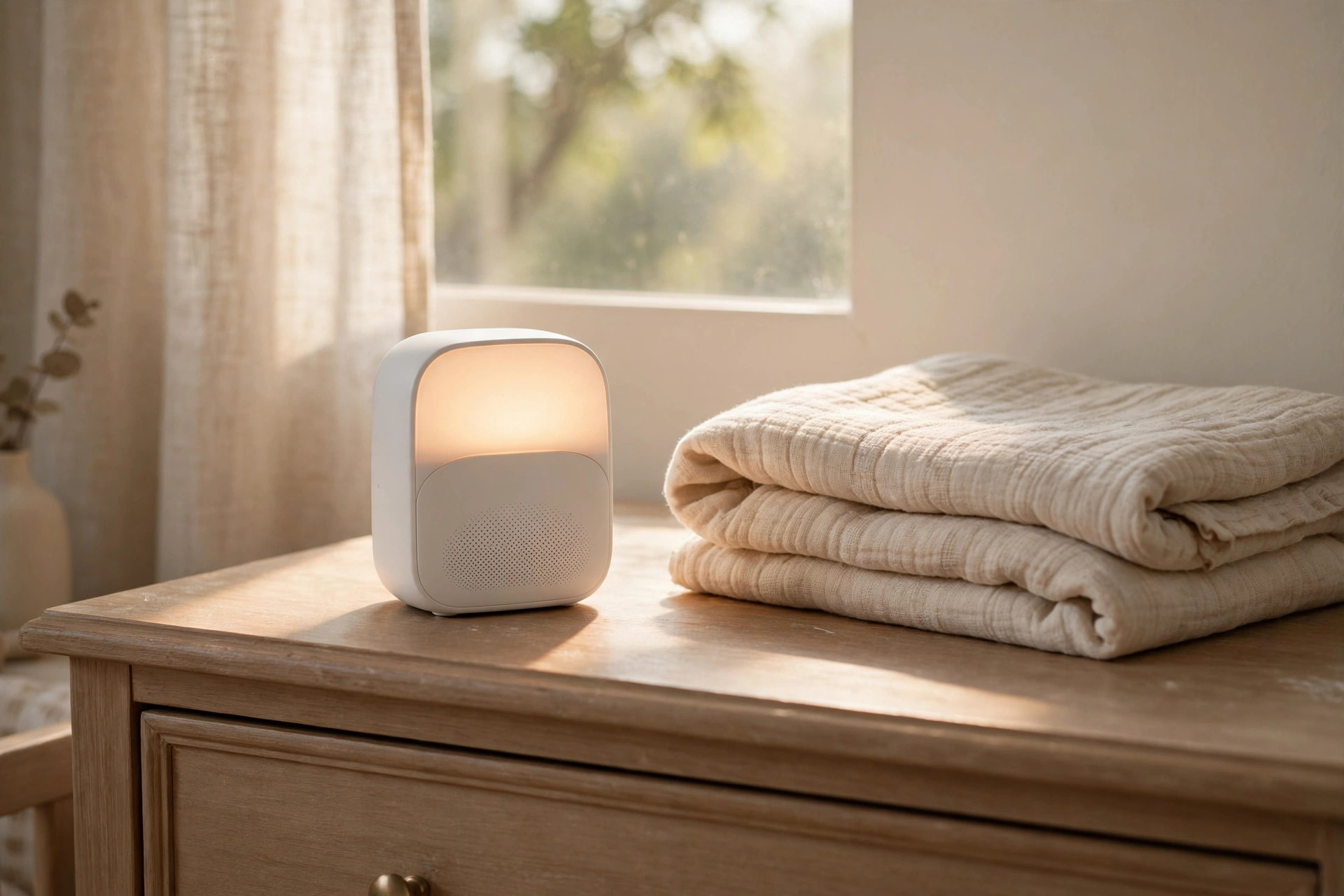
A sound machine is one of the cheapest sleep tools a parent can buy — and one of the most argued about. Used well, steady background sound masks the doorbell, the dog, and the sibling practising recorder in the next room, and gives your baby a consistent sleep cue. Used badly, it is a gadget blaring too loud, too close, on a track that restarts with an audible click every 30 minutes.
Here is how to choose one, and what is actually on sale this week.
Continuous vs looping sound — the spec that matters most
The single most important feature is not the number of sounds. It is whether the sound plays continuously or loops.
Continuous (non-looping) playback generates sound without a seam — no restart point, no gap. This is what you want. Babies stir between sleep cycles; a seamless sound does not give them a reason to fully wake. Looping tracks replay a 20–60 second recording. On cheaper units the loop point is audible — a faint click, a volume dip, a rhythm change. Some babies sleep through it; light sleepers do not.
When you compare models, look for “non-looping”, “continuous play”, or “seamless” in the description. If a listing only says “30 soothing sounds” with no mention of looping, assume it loops.
Volume and distance: the safe setup
Paediatric guidance on sound machines is widely cited and worth following: keep the volume at or below 50 decibels (about the level of a quiet conversation or a running shower), place the machine as far from the crib as practical — across the room, never inside the crib or clipped to the rail at the baby’s head — and start at the lowest volume that does the job.
Two practical rules: first, if you have to raise your voice to talk over it, it is too loud — turn it down until normal conversation is comfortable. Second, distance is free volume control. A machine on the dresser across the room at medium volume is gentler on small ears than a machine on the nightstand at low volume.
Check with your paediatrician if you have questions about your specific setup — especially for premature babies, who are more sensitive to sound.
Travel vs nursery units: buy for where you will use it
Sound machines split into two shapes, and the wrong shape is the most common regret. Nursery units plug into the wall, run all night without battery anxiety, and often bundle a night light or double as part of a monitor system — best if the machine lives in one room. Travel units are compact, battery-powered, and clip to a stroller, car seat, or travel crib; the trade-off is battery life and smaller speakers.
This week’s sound machine deals
{Prices checked October 19, 2026}
Nanit Sound + Light Travel Pack — $106.25 (was $125.00, 15% off). The travel pick: compact, battery-powered, and clips to a stroller or travel crib.
Safety notes
Keep the volume at or below 50 decibels, place the machine across the room from the crib — never inside the crib or at the baby’s head — and check with your paediatrician if you have questions about your specific setup.
Keep reading
How to Choose a Video Baby Monitor (2026)
Baby Monitor Features Compared: Finding the Best Value
{This post contains affiliate links. If you buy through them, we may earn a commission at no extra cost to you.}